This year, I accomplished a feat that I never thought I would: I went undercover to investigate a group that hates me.
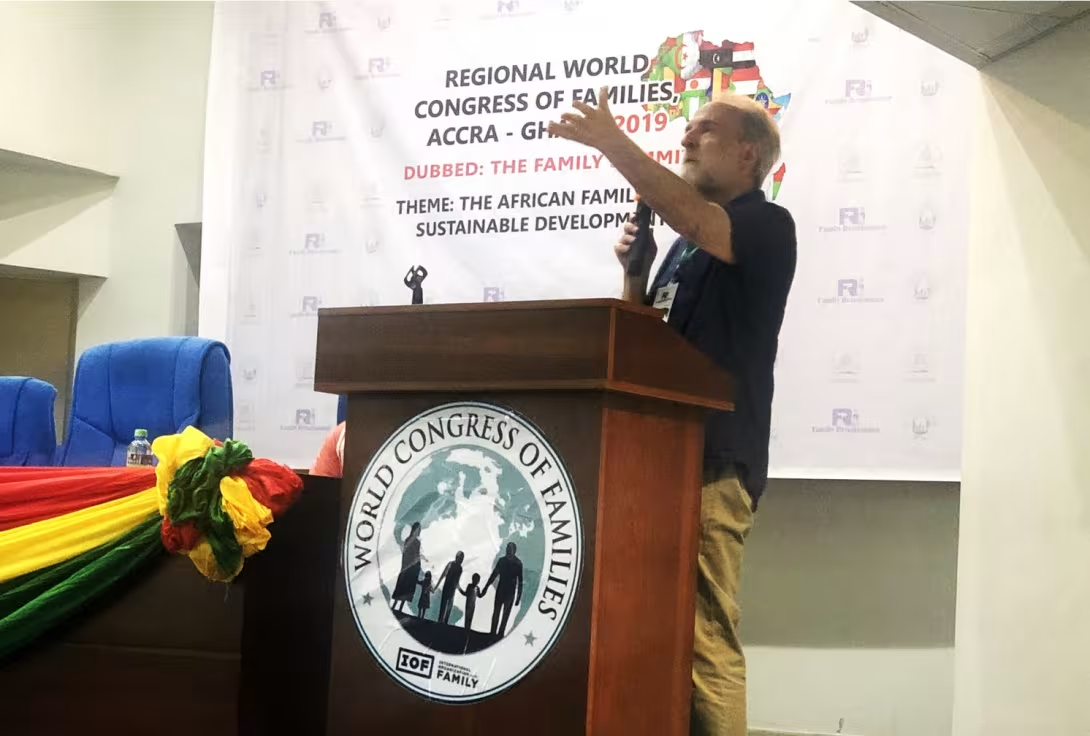
Not long after I took my seat in the auditorium in downtown Accra, Ghana, a series of African and American speakers took turns denouncing me and the people I love. A representative of Ghana’s Prisons Service, for example, condemned LGBTIQ people as a “modus to depopulate the world”, and our sexual orientations as “a major part of why we imprison people in Ghana”.
“If we strengthen the family, there will be less people in prisons, but prison will also serve as a corrective measure for sexual deviants,” she argued. Another Ghanaian speaker, Samuel Okudzeto Ablakwa, an MP from the opposition National Democratic Party, used his time on stage to call on his fellow politicians to declare the country “a no-go area for the LGBT agenda”.
Ablakwa took specific aim at new sex education proposals from the Ghanaian government. Incredibly, he compared the proposals to the historical enslavement of “the strongest members of African families” by European colonisers, with the supposed purpose to “penetrate and wreak havoc” on our societies. The crowd around me, dressed in their Sunday best, listened intently.
This was a remarkable manipulation of our history, which is being commemorated this month via Ghana’s Year of Return, marking 400 years since the first slave ship left our shores for Jamestown, Virginia. Members of the African diaspora around the world have travelled to Ghana to join these events. Meanwhile, at the summit I attended, speakers on stage were clear that LGBTIQ people are not welcome here.
‘A summit of hate’
Who organised this summit of hate? The World Congress of Families (WCF), an elite international network led by US and Russian ultra-conservatives and best known for publicly and militantly opposing LGBT rights and abortion – though its members are also against contraception, comprehensive sexuality education (CSE), divorce, single mothers and multi-generational households.
Recent openDemocracy research further revealed this network’s numerous links to Islamophobic, far-Right and white supremacist movements. Its European allies have called African migrants “slaves” and “poison”. Despite this, most of the speakers at the WCF’s regional conference, held in Accra at the end of October, were from Ghana, Nigeria and other African countries.
The summit’s local host was a group called the National Coalition for Proper Human Sexual Rights and Family Values. Recently, it has led a fierce and well publicised backlash against the government’s new sex education proposals that aim to “provide young people with the knowledge and skill to make informed choices” about their sexual and reproductive health.
In the weeks preceding the conference we heard and read the National Coalition and its allies incessantly denounce the Ministry of Education’s new (and since stalled) sex education guidelines, warning Ghanaians of the pending doom that would await us if they are approved. Opponents claimed that “outside forces” are seeking to infiltrate our schools to poison youth with the “LGBT agenda”.
‘Would I be discovered? Would I be triggered? Would I be asked to commit my life to Jesus Christ before I even entered the event?’
The rights of LGBTIQ people are already heavily restricted in Ghana. Hate crimes are common, but rarely monitored and challenged even less frequently. The WCF speakers were right that there’s a link with colonialism – but not the one they claimed. Rather, our laws criminalising homosexuality come straight from the British Empire (though they were retained after independence).
The recent assault against CSE is thus just the latest in a never-ending witch hunt against sexual minorities in the country. This was the context in which I gathered my courage and entered the Ghana Shippers Authority building – the downtown Accra venue for the WCF conference – which was surrounded by armed police.
Preparing for the summit, I was unsure of what to expect. I was also deeply conflicted. I am a queer feminist activist. Would I be discovered? Would I be triggered? Would I be asked to commit my life to Jesus Christ before I even entered the event? My main concern was staying at the conference long enough to learn about this network’s strategies and plans for the next year.
At the venue, organisers were clearly keeping a watchful eye over who entered and exited. I’d heard that activists and some journalists had been forcefully removed from previous WCF events in Europe, for attempting to infiltrate this movement. I was aware that my presence had to be carefully managed, but moved forward with a deep sense of conviction and a bold curiosity.
Before entering the building, I passed tables of flyers, books and DVDs with titles such as ‘Dangerous Relations: The Threat of Homosexuality’ and ‘The Power of a Praying Husband’, as well as ‘The Seven Principles of Success and Wealth Creation: Experiences of an Accomplished Entrepreneur’. Inside, young and bright-eyed usherettes guided me to the main hall.
https://www.opendemocracy.net/en/5050/god-has-a-new-africa-undercover-in-a-us-led-anti-lgbt-hate-movement